
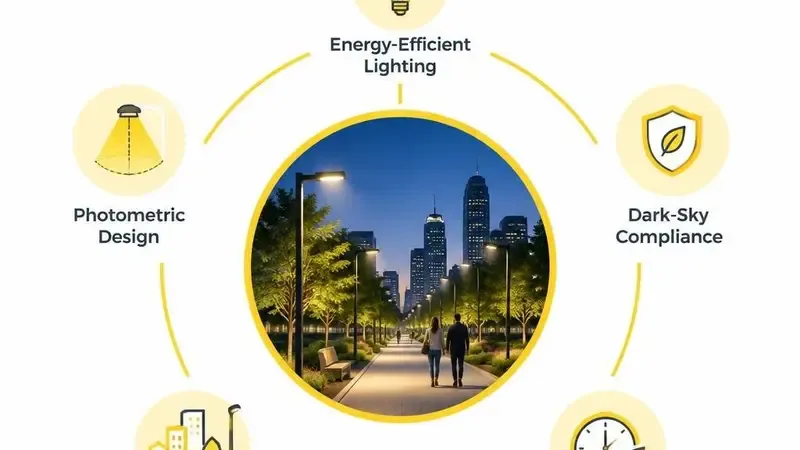
Core Principles of Sustainable Urban Lighting Infrastructure
In an increasingly urbanized world, the illumination of our public spaces plays a far more critical role than simply banishing darkness. Thoughtful public space lighting solutions are foundational to creating vibrant, safe, and sustainable communities, directly influencing everything from citizen well-being to urban identity.
As we look towards September 2026 and beyond, cities are embracing innovative strategies to optimize their nocturnal landscapes. This involves moving beyond traditional illumination methods to integrate advanced technologies and human-centric design principles.
The evolution of public lighting has brought significant advancements, especially in energy-efficient lighting solutions. These developments are not only transforming how we light our cities but also how we manage resources and impact the environment.
In this extensive guide, we will explore the core principles of sustainable urban lighting infrastructure, examining its multifaceted impact on safety, ecology, and the overall urban experience. We will also delve into the strategic implementation of smart technologies and best practices for creating eco-friendly, resilient city environments.
At the heart of effective public space lighting lies a blend of technical precision and human understanding. Sustainable urban lighting infrastructure is built upon core principles that extend beyond mere brightness, encompassing photometric design, intelligent luminaire spacing, superior energy efficiency, stringent dark-sky compliance, and an appreciation for urban aesthetics and asset longevity.
We understand that lighting must be carefully related to the evening functions of a particular space, prioritizing pedestrian activity over vehicular traffic where appropriate. This human-centric approach ensures that our solutions are not just functional but also enhance the lived experience of urban dwellers. Through meticulous photometric analysis, we can ensure even light distribution, eliminating dark spots and over-illuminated areas.
The coordination of light fixtures with existing street character, architectural details, and the natural tree canopy is crucial for maintaining aesthetic harmony. We strive to select luminaires that are compatible with community preferences and neighborhood character, designing them as part of a coordinated line of amenities. This ensures that different fixtures, serving varied purposes, relate to one another as part of a cohesive family, reinforcing the unique identity and history of an area.
Modern advances in lighting technology have significantly improved the energy efficiency of new light fixtures. By utilizing model specifications for networked outdoor lighting control systems, we can further reduce energy consumption and operational costs. Our goal is to reduce light pollution, minimize ecological impacts, and achieve substantial energy savings, contributing to a more sustainable urban environment. This includes employing full-cut off fixtures, glare shields, dimmer and timing controls, and warm color temperatures, directing light precisely where it is needed. Adherence to guidelines established by the Illuminating Engineering Society of North America (IES) is paramount for ensuring sufficient light values and uniformity, balancing safety with environmental responsibility.
Enhancing Pedestrian Safety in Urban Lighting Infrastructure
Public space lighting is a powerful tool for enhancing safety and security, directly impacting the well-being of citizens. Statistics highlight the critical need for effective illumination: in Canada, for instance, 60% of pedestrian fatalities resulting from automotive collisions happen at night. Furthermore, surveys reveal that many individuals, particularly women, feel less safe walking at night, underscoring the role of lighting in perceived security.
Thoughtful lighting increases safety in areas people use, aiding in geographic orientation and deterring criminal activity. We focus on enhancing safety at doorways, transit stops, and building entrances, ensuring these crucial points are well-lit to encourage use and improve security.
Beyond basic illumination, lighting can also serve as a traffic-calming device. By strategically using light to signal a change in zone, we can encourage drivers to slow down on pedestrian-oriented streets, reducing the risk of accidents. The quality of light is also paramount; choosing light sources that provide good color rendition and visual clarity is essential. For instance, while traditional high-pressure sodium lighting casts a yellowish-orange glow, modern alternatives offer soft, white light that improves visual clarity and reaction time for both pedestrians and vehicles.
To optimize safety and comfort for pedestrians, luminaires should be located at a height appropriate for sidewalk users, not just vehicles. Consistent illumination along sidewalks is critical to prevent dark intervals that can create feelings of vulnerability. An improved public lighting network helps those who feel vulnerable to harassment and violence feel more secure by making outdoor spaces more visible and inviting. Recent LED street light improvements at high-collision intersections have already demonstrated measurable progress towards reducing traffic fatalities, showcasing the tangible impact of smart lighting design.
Ecological Preservation and Dark-Sky Compliance
Minimizing light pollution and ecological impacts is a cornerstone of sustainable urban lighting. The unchecked spread of artificial light at night, known as light pollution, disrupts natural ecosystems, interferes with astronomical observation, and can negatively affect human health. Our commitment is to design lighting solutions that respect the nocturnal environment.
A key strategy for dark-sky compliance involves the use of full-cut off fixtures. These luminaires are designed to direct all light downward, preventing any upward light spill that contributes to skyglow. By avoiding glare through effective shielding and precise aiming, we ensure that light is concentrated only where it is needed, reducing wasted energy and minimizing environmental disturbance.
The choice of light source and its color temperature also plays a significant role. Warm color temperatures (typically below 3000K) are generally preferred as they have less impact on wildlife and human circadian rhythms compared to cooler, bluer light. This approach supports wildlife protection, particularly for nocturnal animals whose behaviors can be altered by excessive or inappropriate lighting.
Furthermore, energy conservation is inherently linked to dark-sky initiatives. LEDs consume significantly less energy than traditional lamps to offer the same light output. By implementing smart controls such as dimmers and timing mechanisms, we can reduce light levels during off-peak hours, achieving substantial cost savings—potentially up to 50%—while further reducing light pollution. The quality of light, including its brightness and distribution, must be carefully adjusted to suit the scale of the pedestrian and the road, avoiding excessive glare while ensuring adequate illumination without over-lighting. This balanced approach is vital for minimizing our ecological footprint and preserving the natural night sky.
Human-Centric Design and Visual Comfort
Creating public spaces that are both functional and enjoyable requires a deep understanding of human perception and comfort. Human-centric lighting design focuses on visual comfort, avoiding glare, and enhancing the overall user experience.
Glare, often caused by excessively bright or improperly aimed light sources, can be highly uncomfortable and even dangerous, reducing visibility and creating a sense of unease. Best practices for ensuring visual comfort include careful luminaire selection, appropriate mounting heights, and the use of glare shields. The quality of light, including its color rendition and visual clarity, is crucial. For example, while older high-pressure sodium lighting casts a yellowish-orange glow that compromises visual clarity, modern LED and metal halide lighting offers a soft, white glow with accurate color rendition. This improves visual comfort and allows for better recognition of faces and objects, enhancing perceived safety.
We advocate for luminaire heights appropriate for pedestrians on the sidewalk. Reducing luminaire height and increasing fixture density can create a stronger, more inviting edge along the sidewalk, reinforcing it as a habitable space. This approach, scaled to the pedestrian rather than solely to vehicular traffic, fosters a more intimate and comfortable environment.
Lighting also plays a vital role in wayfinding and enhancing the aesthetic appeal of public spaces. Well-lit maps and directional signage provide clear nighttime orientation. Illuminating sculpture, fountains, and bridges can transform them into distinctive landmarks, guiding citizens through urban areas. Architectural accents, such as highlighting archways and cornices, emphasize an area’s uniqueness and historical details, creating a sense of drama and identity. Even landscaping with small, strategically placed lights can impart a magical feeling, drawing positive attention and fostering a welcoming atmosphere in parks and plazas.
Feature High-Pressure Sodium (HPS) LED (Light Emitting Diode) Color Temperature Warm (yellow-orange) Wide range (warm to cool white) Color Rendition Poor (distorts colors) Excellent (accurate colors) Energy Efficiency Moderate High Lifespan Moderate (24,000 hrs) Very Long (50,000-100,000+ hrs) Dimming Capability Limited Excellent Instant On/Off No Yes Environmental Impact Contains mercury Mercury-free Strategic Implementation for Smart, Eco-Friendly Cities
The future of public space lighting is intrinsically linked to smart technology and broader smart city initiatives. As we move towards September 2026, the strategic implementation of intelligent lighting systems is critical for creating eco-friendly, resilient, and highly functional urban environments. This involves leveraging smart city connectivity, advanced sensor networks, and a keen focus on lifecycle cost and asset management, all contributing to urban decarbonization goals.
The integration of lighting with other urban infrastructure is a key aspect. Modern public lighting systems are no longer isolated units; they are integral components of a larger smart city ecosystem. This connectivity allows for dynamic adjustments, proactive maintenance, and valuable data collection that informs urban planning and resource allocation.
When considering new installations or upgrades, it’s crucial to look beyond the initial purchase price. We emphasize the long-term Return on Investment (ROI) and the Total Cost of Ownership (TCO). Upgrading to advanced, energy-efficient solutions is a strategic way to stop blowing the budget on excessive energy consumption and frequent maintenance. While cheap lights might seem appealing initially, they often cost more in the long run due to higher energy bills, shorter lifespans, and increased maintenance requirements. Focusing on quality, durable, and intelligent solutions ultimately yields significant savings over the system’s operational life.
Integrating Smart Urban Lighting Infrastructure with IoT
The Internet of Things (IoT) is revolutionizing public space lighting, transforming static illumination into dynamic, responsive, and data-rich networks. Smart technology and connectivity play a pivotal role in modern public lighting, enabling unprecedented levels of efficiency, control, and adaptability.
Networked lighting controls are at the forefront of this transformation. These systems allow for remote management and monitoring of individual luminaires or entire lighting grids. This capability enables adaptive dimming, where light levels can be adjusted in real-time based on ambient conditions, time of day, or specific events. Motion sensing technology further enhances efficiency, ensuring that areas are fully illuminated only when occupied, leading to significant energy savings.
Beyond energy conservation, smart lighting systems offer substantial operational savings. Remote fault monitoring allows city managers to identify and address issues like lamp failures or power outages proactively, reducing maintenance costs and improving response times. Energy metering capabilities provide precise data on consumption, enabling better budgeting and performance optimization. These integrated systems can achieve up to 50% cost savings through energy-efficient LED lighting and intelligent scheduling. Our luminaires, for example, are designed to reach and exceed 100,000 hours, or more than twenty years of operation, drastically reducing the frequency and cost of replacements.
The integration of lighting with other urban infrastructure and smart city initiatives extends its utility far beyond mere illumination. Smart light poles can host a variety of sensors for air quality monitoring, traffic management, public Wi-Fi, and even surveillance, acting as a backbone for broader smart city applications. This holistic approach creates a truly connected and responsive urban environment.
Lifecycle Management, Standards, and Solar Integration
Effective lifecycle management is paramount for ensuring the long-term performance, sustainability, and cost-effectiveness of public space lighting assets. This involves adhering to rigorous standards, planning for longevity, and exploring innovative solutions like solar integration.
Our luminaires are engineered for durability, often exceeding 100,000 hours of operation—equivalent to more than two decades of service. This extended lifespan significantly reduces the frequency of replacements and associated labor costs, contributing to a lower Total Cost of Ownership.
Compliance with industry standards, such as those set by the Illuminating Engineering Society of North America (IES), is fundamental. These guidelines ensure that lighting installations meet specific requirements for light levels, uniformity, and quality, promoting safety and visual comfort. Beyond performance, structural durability of poles and fixtures is critical, especially in diverse urban environments subject to various weather conditions and potential impacts.
Preventive maintenance is a key component of lifecycle management. Regular inspections, cleaning, and timely repairs can prevent minor issues from escalating into costly problems, extending the operational life of the assets. This proactive approach ensures consistent performance and maximizes the investment in lighting infrastructure.
For specific applications, off-grid solar lighting presents a compelling, sustainable solution. Where grid connectivity is challenging or expensive, and where local conditions are suitable, solar-powered street and area lights can be a technically and cost-effective option. Advances in battery storage and solar panel efficiency have made these systems increasingly reliable and viable, further contributing to decarbonization efforts and reducing reliance on traditional energy sources. Communities considering solar solutions can now access comprehensive fact sheets and technical resources to evaluate their specific needs and determine the optimal approach.
Here are some essential design and maintenance best practices for municipal lighting assets:
- Prioritize LED Technology: Leverage the superior energy efficiency, longevity, and control capabilities of LED luminaires.
- Conduct Photometric Analysis: Ensure optimal light distribution, uniformity, and minimal spill for every installation.
- Specify Full-Cutoff Fixtures: Minimize light pollution and skyglow by directing all light downward.
- Integrate Smart Controls: Implement networked systems, dimming, and motion sensors for adaptive lighting and energy savings.
- Adhere to IES Standards: Ensure compliance with recognized industry guidelines for light levels and quality.
- Plan for Longevity: Select durable materials and fixtures with extended lifespans (e.g., 100,000+ hours).
- Implement a Proactive Maintenance Schedule: Regularly inspect, clean, and repair components to prevent failures and extend asset life.
- Consider Solar Integration: Evaluate off-grid solar solutions for remote areas or to enhance energy independence.
- Design for Visual Comfort: Minimize glare through appropriate shielding, mounting heights, and warm color temperatures.
- Document and Manage Assets: Maintain comprehensive records of all lighting assets, including as-builts and warranty information, for efficient lifecycle management.