
Key Takeaways
- The best Bellingham neighborhood depends on your routines, budget, housing needs, and long-term plans.
- Compare complete monthly ownership costs, not just the purchase price.
- Commute routes, parking, sidewalks, hills, transit, and nearby services can affect daily satisfaction.
- Property condition and housing styles can vary substantially from one area to another.
- Planned development, zoning, and public improvements may influence future convenience and resale appeal.
- A simple scorecard helps buyers compare neighborhoods with more clarity and less pressure.
Table of Contents
- Why Neighborhood Choice Matters
- Start With Your Priorities
- Compare the Full Cost
- Review Housing Types and Conditions
- Test Daily Life in Person
- Check Plans, Zoning, and Future Changes
- Use Local Data With Care
- Build a Neighborhood Scorecard
- Questions to Ask Before Choosing an Area
- Common Questions
- Conclusion
Buying a home in Bellingham means choosing more than an address. It means choosing the setting for ordinary mornings, grocery runs, work trips, dog walks, weekend plans, and the amount of time spent behind the wheel. A home near downtown, Fairhaven, Lake Whatcom, or the city’s northern neighborhoods can support very different lifestyles even when the homes appear similar online.
For buyers weighing those tradeoffs, Bellingham, WA real estate experts Julian & Company offer home-search, neighborhood, buying, selling, and valuation resources. Julian & Company serves Bellingham, Whatcom County, and surrounding communities, and its local focus can be useful when comparing property types, community character, and the practical details that shape a home search.
- Why Neighborhood Choice Matters
Two homes with comparable prices can create very different ownership experiences. One may offer a shorter route to work, restaurants, and waterfront paths, but have a smaller lot or limited off-street parking. Another may provide more space, privacy, or storage but require more driving for errands and appointments.
Consider a buyer deciding between a compact home closer to major services and a larger home farther from the city center. The larger home may be the better fit if outdoor space and room to grow matter most. The smaller home may win if the buyer values a simpler commute and easy access to daily destinations. Neither choice is automatically better. The right answer comes from matching the location to real routines.
- Start With Your Priorities
Before touring, divide your wish list into must-haves and preferences. Must-haves are the features that make a home workable. Preferences are valuable, but they should not override the essentials.
Useful priorities to define
- Your maximum purchase price and comfortable monthly payment.
- Your preferred home type, such as a detached house, condo, or townhome.
- Commute time, parking needs, and access to transit or bike routes.
- Need for bedrooms, a home office, a garage, storage, or a yard.
- Access to parks, trails, grocery stores, healthcare, and dining.
- Your preference for a quieter residential setting or a more active urban environment.
- Future plans involving pets, children, relatives, remote work, or rental flexibility.
- Compare the Full Cost
Listing price is only one part of affordability. Build a monthly estimate for homes in at least three areas so that you can compare the complete cost of living in each location.
- Mortgage principal and interest.
- Property taxes and homeowner’s insurance.
- Condo or homeowners association dues, if applicable.
- Utilities, internet, fuel, transit, and parking.
- Routine repairs, landscaping, and long-term maintenance.
- Potential shared-area costs, special assessments, or service fees.
An older house may have a lower purchase price but require closer attention to systems and deferred maintenance. A condo may reduce exterior upkeep while adding monthly dues and community rules. Comparing these items early can keep a seemingly affordable option from stretching the budget after closing.
- Review Housing Types and Conditions
Neighborhood fit and property condition should be evaluated together. Bellingham buyers may encounter older homes, newer construction, condominiums, townhomes, hillside properties, waterfront-adjacent homes, and houses with larger lots. Each brings a different maintenance profile and set of questions.
- Ask about the age and condition of the roof, siding, windows, plumbing, electrical, and heating systems.
- Review driveway access, garage usability, visitor parking, and street parking.
- Look closely at drainage, slopes, mature trees, retaining walls, and outdoor surfaces.
- Listen for traffic, rail, commercial activity, campus activity, or other recurring noise.
- For condos, examine association documents, reserves, rental policies, pet rules, and assessments.
- Verify permits and records for additions, remodels, decks, or accessory structures.
- Test Daily Life in Person
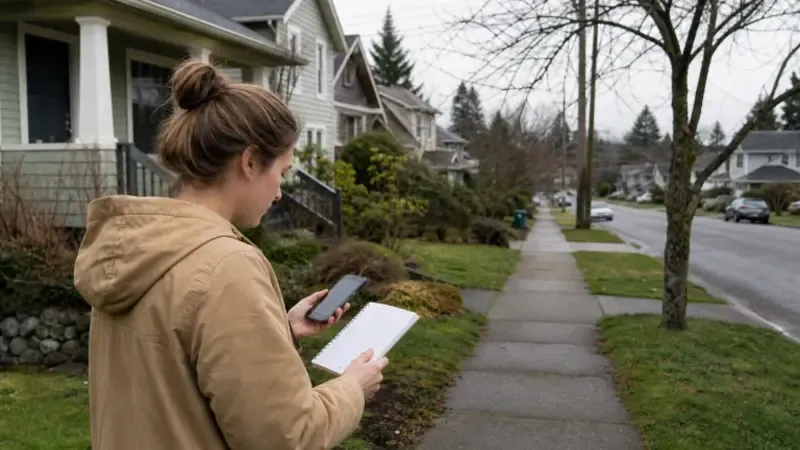
A quiet showing on a weekend afternoon does not always reveal weekday traffic, school drop-off activity, evening parking pressure, or nighttime noise. Visit promising areas more than once and at different times whenever possible.
- Drive the route during a weekday morning.
- Return during the evening commute.
- Walk nearby blocks and note sidewalks, crossings, lighting, and bike connections.
- Test the routes to work, schools, grocery stores, medical care, and regular activities.
- Visit on a weekend to see how the area feels outside the workweek.
Online maps are useful, but they cannot fully show how a route feels in the rain, on hills, during busy periods, or when parking is limited. Personal observation adds context that listing photos cannot provide.
- Check Plans, Zoning, and Future Changes
Nearby development can change traffic patterns, services, housing supply, and the character of an area. Before making a final offer, review the City of Bellingham’s comprehensive planning information to understand how public policy addresses future land use, housing, transportation, and community infrastructure.
Research proposed road work, sidewalk projects, new housing or commercial construction, park and trail improvements, utility work, and environmental considerations. Planned improvements can add convenience, but they may also bring construction activity, density, or new traffic patterns.
- Use Local Data With Care
Citywide market averages can hide important differences between neighborhoods and property types. Compare homes with similar size, condition, location, and features whenever possible. The city’s Bellingham housing statistics can provide useful context on local housing patterns and public data sources.
For a current purchase decision, focus on recent comparable sales, active competition, days on market, price changes by property type, and differences between detached homes, townhomes, and condos. Automated values can be a starting point, but they may not reflect renovations, views, lot conditions, or a property’s precise micro-location.
- Build a Neighborhood Scorecard
A scorecard can prevent one attractive kitchen, view, or listing photo from dominating the entire decision. Give each neighborhood a score from one to five in categories that matter to your household.
- Budget fit:Purchase price, taxes, insurance, fees, utilities, and expected maintenance.
- Daily convenience:Access to shopping, healthcare, parks, restaurants, and services.
- Commute:Travel time, traffic, transit, parking, and bike access.
- Home fit:Layout, lot, storage, condition, and space for daily routines.
- Future flexibility:Resale considerations, planned changes, and capacity for changing needs.
Add personal categories where needed, such as trail access, water access, proximity to family, privacy, or school location.
- Questions to Ask Before Choosing an Area
- What will the complete monthly housing cost be?
- How long will travel take during normal commute hours?
- Which services are close enough to use regularly?
- Are there drainage, slope, shoreline, or infrastructure concerns to investigate?
- What public or private projects are planned nearby?
- Could association rules limit future plans for pets, rentals, renovations, or parking?
- Will this location still work if household needs change?
- Which features could affect resale appeal later?
- Common Questions
What is the best neighborhood in Bellingham?
There is no single best option for every buyer. Budget, home type, commute, outdoor access, noise tolerance, and future plans should guide the decision.
Should buyers choose the home or the neighborhood first?
Start with a short list of suitable areas, then compare homes within them. This approach reduces the chance of choosing a property that creates difficult daily tradeoffs.
How many neighborhoods should buyers compare?
Comparing at least three areas is often enough to identify meaningful differences without making the search unnecessarily complicated.
What should relocation buyers do if they cannot visit?
Use live video tours, inspection reports, insurance quotes, detailed route reviews, public planning information, and conversations centered on your daily routine.
Conclusion
A smart Bellingham neighborhood decision balances cost, convenience, home condition, lifestyle, and future flexibility. By visiting at different times, researching planned changes, comparing complete costs, and scoring each area against your priorities, you can choose a home that works well long after closing day.